The trend line is the argument.
Identical slurry, two parallel leach streams: one dosed manually by shift operators, one held on setpoint by a PAS analyser in closed loop. We have run this comparison at customer plants: the pattern is always the same.
The setup
Take identical slurry after thickening and split it into two parallel streams. One stays exactly as the plant has always run it: shift operators dosing cyanide from periodic manual titrations. The other is controlled by a PAS on-line analyser measuring free cyanide continuously and driving the dosing valve in closed loop.
Same ore, same flow, same target: the only variable is the control method.
Between tests, the stream runs blind
A manual titration is a single snapshot. The operator reads free cyanide, adjusts the dosing valve, and walks away, and the next test might come two hours later or six, depending on the shift and the workload. In that gap there is no measurement and no feedback, so as ore consumption shifts the stream drifts off target and stays there until someone takes the next sample.
The closed-loop stream never runs blind. The PAS analyser measures free cyanide every few minutes and corrects continuously, taking flow as feed-forward, so it tracks the changing consumption instead of chasing it hours later.
The losses you never see
This is the part that never reaches a logbook. The plant only records free cyanide at the moment of each test, and the operator corrects toward setpoint each time, so every recorded reading looks healthy. The overshoots that waste cyanide and the dips that lose gold happen in the hours between tests, where nothing is measured. The longest gaps tend to fall off-shift, when the next titration is furthest away.
What it costs
Both ends of the swing are money. The peaks are cyanide bought and destroyed for no metallurgical benefit; the troughs are gold that does not dissolve and is not recovered. Because they fall between tests, neither appears in the manual record, so the bill is paid without ever being itemised. The running totals on the trace above are an illustration of exactly that: cost accruing in the gaps, unseen.
Across the industry, plants report improved cyanide consumption and steadier recovery after closed-loop control goes in. The exact figures remain confidential to each site, but the direction is consistent.
Three findings, one conclusion
The gaps are structural, not a training problem
Manual dosing depends on periodic titrations, hours apart and irregular. Between readings the operator is blind, so the stream drifts off target and is only corrected at the next test. No amount of diligence closes the gap: only continuous measurement does.
The losses never show up in the log
The plant only records each test, so the overshoots and dips between tests are never seen or counted. A circuit can read on-spec at every check while cyanide is wasted and gold is lost in the gaps. Closed-loop measurement makes the whole picture visible.
Feed variation needs feed-forward
Operators get no real-time warning when ore characteristics or flow change. The analyser's dynamic control algorithm takes flow input directly, adjusting dosing as cyanide consumption changes, before the deviation, not after it.
This control loop ships in the TAC 1000-NG
The closed-loop dosing described in this note is a standard capability of the current TAC range. The TAC 1000-NG measures free and WAD cyanide on-line, self-calibrates, and drives cyanide addition directly, with the same dynamic algorithm handling variable ore consumption.
Speak to an Expert View the TAC range →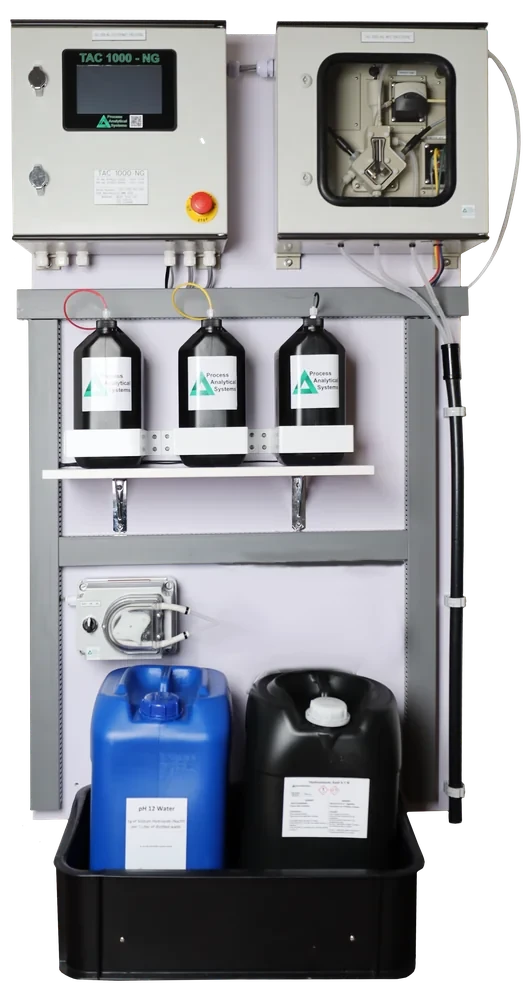
What would your trend line show?
Tell us about your leach circuit and we'll walk you through what closed-loop cyanide control would look like on your plant.
Speak to an Expert